
Updated 6 October 2026. Evidence-informed guidance, with practical coaching examples.
A productive session gives you something to build on. Recording what you did—and how you responded—helps you decide what to repeat, what to progress and when to make the session easier.
You can begin with a notebook or a simple training log. For a sprinter or team-sport athlete, electronic timing adds information that a record of sets and repetitions cannot provide.
Tracking makes progressive overload a decision
Progressive overload means adjusting the training stimulus as your capacity develops. Depending on the goal, that might involve more resistance, additional repetitions, a carefully chosen increase in volume, or progressing an exercise. It does not require a personal best every workout. The ACSM recommends building resistance training gradually and matching it to the outcome you want. [1]
A record also helps you recognise progress that is easy to miss: the same load with more controlled repetitions, less effort at the same workload, or a repeatable sprint performance after an appropriately planned training block. Keep the exercise, range of motion and test conditions comparable before declaring an improvement.
What to record without overcomplicating it
- The work: exercise, load, sets and repetitions—or sprint distance, repetitions and times.
- The conditions: rest periods, exercise setup and any change to the planned session.
- The effort: how challenging the work felt. In the gym, an estimate of repetitions in reserve means how many more good repetitions you think you could have completed.
- The context: unusual fatigue, poor sleep, soreness, pain or a demanding match earlier in the week.
These are practical logging suggestions, not a requirement to collect every possible metric. The useful record is the one you can maintain and use.
Use the information during the session
Suppose the plan is three sets of eight repetitions with a couple of good repetitions left in reserve. If the first set is unexpectedly close to your limit, you might extend the rest, reduce the load or reduce the remaining work. If the session is comfortably within the intended effort and technique remains consistent, a small progression may be appropriate.
This is an example of autoregulation: adjusting the plan to your performance that day. Research has compared effort- and velocity-based approaches with fixed prescriptions, but does not establish that every autoregulated method is always superior. The purpose here is to make an informed adjustment, not to chase a fashionable training system. [2]
Pain is not simply another score to push through. Stop the provoking activity and seek appropriate assessment when symptoms are new, significant or persistent.
Use the record to plan what comes next
After training, compare the completed session with the intended session. Did you meet the repetitions at the intended effort? Was the movement consistent? Did performance recover with more rest? Look for patterns across several comparable sessions rather than rebuilding the programme after one difficult day.
A practical example: once you repeatedly reach the top of your planned repetition range with the intended technique and effort, a small load increase may be the next step. If performance repeatedly declines, review training volume, recovery and the wider schedule before adding more work. This example illustrates a decision process; it is not a universal progression rule.
Discuss a structured training plan with me.
For speed athletes, measure speed—not just tiredness
Sprinters and athletes in sports such as football and rugby need to know whether their speed work is meeting its purpose. A session can feel demanding without producing high-quality sprinting.
Depending on the athlete and the training goal, you might monitor a short acceleration distance, a longer sprint, or a flying segment after a run-in. These measure different aspects of performance. Compare like with like: start procedure, timing method, distance, surface, footwear, rest and weather can all influence the result. Research on sprint monitoring shows that differences in starting and timing procedures can dwarf the improvements you are trying to detect. [3]
If repeated times deteriorate beyond the variation you normally see, use that information alongside technique and how the athlete feels. More recovery, fewer repetitions or ending the speed work may be sensible when the aim is maximal speed. There is no single percentage drop that suits every athlete, session and timing setup.
Where a portable Freelap timing system fits
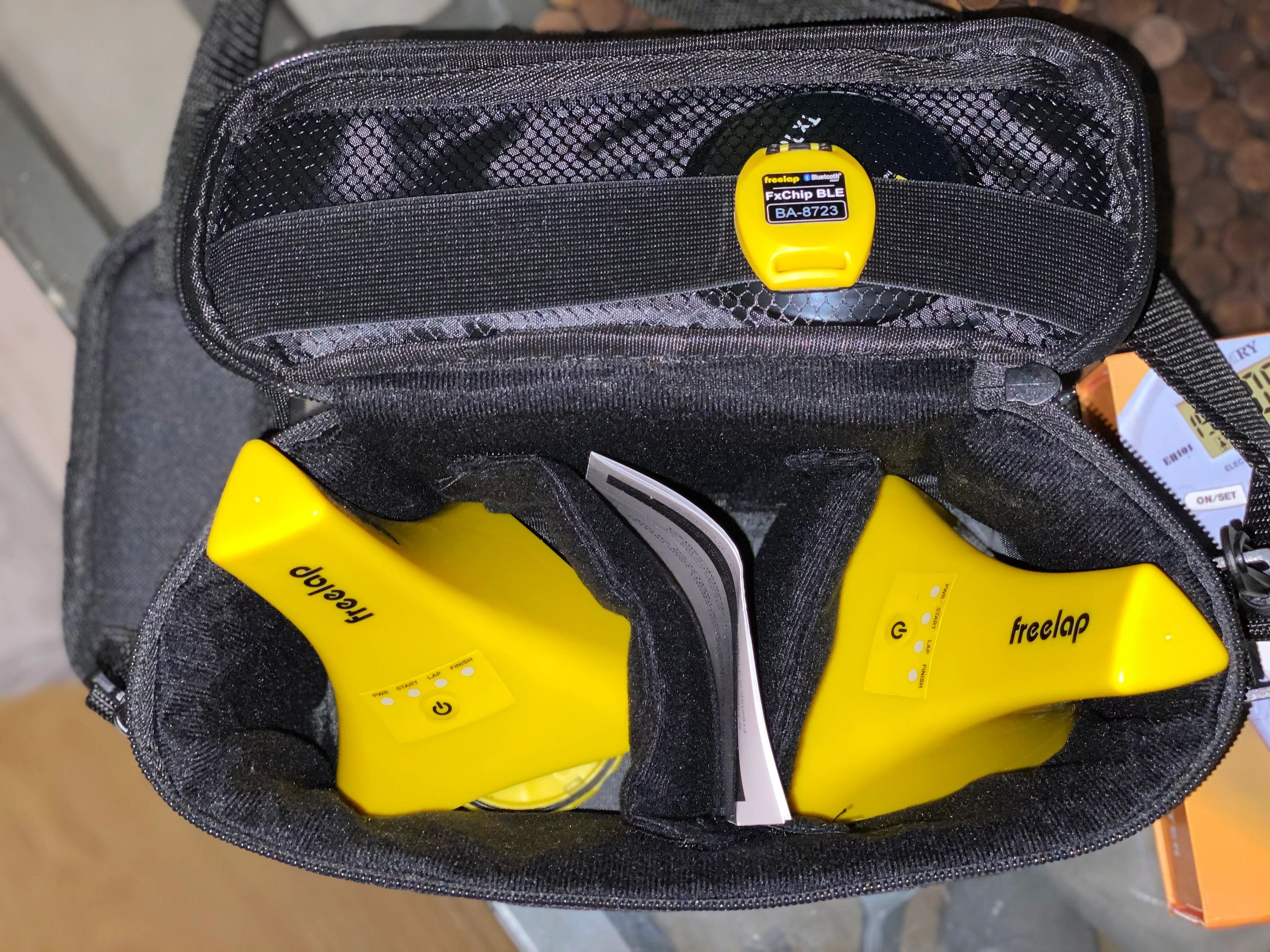
The device in my original post is a Freelap electronic timing system. Its components include transmitters placed around the course and a transponder worn by the athlete, with results collected through a compatible app or relay. The exact equipment and setup determine which starts, splits and finishes you can measure. [4]
That makes it relevant both to track sprinters and to team-sport athletes who want repeatable running tests. Freelap also provides sport-specific setup guidance for football and American football. [5] You can use the results to compare repetitions during a session and review performance across a training block.
Follow the instructions for your particular kit, keep the setup consistent and interpret small changes cautiously. Electronic timing is not error-free, and a training time should not be treated as interchangeable with an official race result. A timing kit measures performance; it does not improve speed on its own.
Turn your training record into useful progress
Knowing your numbers is the start. Choosing what they mean for your next session is where a clear programme and coaching feedback become valuable.
I offer personal training in Rainham, Kent, online coaching and sports-performance coaching. Tell me about your goals, experience and current training, and I can discuss the support that fits—from learning to track gym sessions to planning more purposeful speed work.
Discuss your training and performance goals · Explore sports-performance coaching
Evidence and further reading
This is a practical overview, not a systematic review conducted for this website. The coaching examples are illustrations. Manufacturer documentation explains equipment operation and is separate from independent training research.
- ACSM (2026). Official summary of the resistance-training position stand.
- Larsen et al. (2022). Load and volume autoregulation: systematic review and meta-analysis.
- Haugen & Buchheit (2016). Sprint performance monitoring: methodological and practical considerations.
- Freelap. System components and getting started. Manufacturer documentation, checked October 2026.
- Freelap. Football timing guide and American-football timing guide.